Saturday, November 27, 2010

there was a word


 ... you didn't say. Pen in hand, I took note.

What you may not know is that unsaid words and seething silences are my element. My tempestuous soul thrives on boiling waters, rough seas. However dark.

Yet, feigned indifference frets, wears it away like an acid tide.
Please have mercy on it.


(But I shall ride out this storm, don't worry. I will.)


*       *       *

There was
a word
in the dark.
Minuscule. Ignored.

It hammered in the dark.
It hammered
on the ground of water.

From the depths of time,
it hammered.
Against the wall.

A word.
In the dark.
Beckoning me.


Eugénio de Andrade, 'Havia uma Palavra', from Matéria Solar [Solar Matter].
Translated from the Portuguese by DK.

Thursday, November 25, 2010

eia, quis me amabit...?

Even though I have never been one to feel I could ever become 'rooted in one dear perpetual place', age and the current economic woes have compelled me, in recent times, to search for a more permanent job in academia.

Every time an opportunity arises, however, I get cold feet. The mere thought of spending the rest of my life in a small provincial town (and are there any permanent academic jobs elsewhere...?), stifled by administrative chores and bored silly with no one interesting to talk to fills my heart with dreams of wandering. The hell with dear perpetual places! The hell.

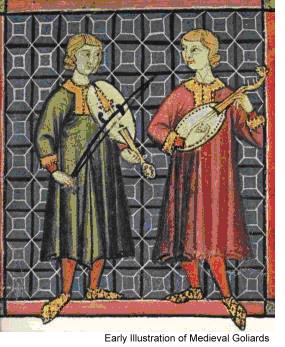
At iffy moments like these I find myself cherishing bygone ideals of scholarship, imagining how much more riveting and suited to my malcontent character, to my chronic detachment from money and status concerns, the life of one of those maverick medieval wandering scholars would have been.

A life wholly unconcerned with social and moral conventions as well as with the pettiness of local communities. A life wholly devoted to the pursuit of both knowledge and pleasure, beauty, love, as expressed through poetry, song, performance.

How far, far away modern scholarship has come from all this. And how dishearteaningly sad it is. Most definitely, I was born in the wrong age - too late in a world too old.

That is why the world of the Carmina Burana was in my mind a  lot on this last trip to nowhere. Its touching, unruly poetry gently reminding me of what should truly matter in life, however difficult the choices and prospects may seem.

Lest I forget and bury myself in the sand once again.

Lest I forget thee.

*       *       *

Floret silva nobilis
floribus et foliis.
ubi est antiquus meus amicus?
hinc equitavit.
eia, quis me amabit? 

Floret silva undique.
Nach mime gesellen ist mir we.
Gruonet der walt allenthalben,
wa ist min geselle also lange?
Der ist geriten hinnen.
Owi, wer sol mich minnen? 


The noble forest is in bloom with flowers and leaves.
Where is my old companion?
He has ridden away.
Alas, who will love me? 

The forest is in bloom on all sides.
I grieve for my companion.
The forest is green on all sides.
Why is my companion so long?
He has ridden away.
Alas, who will love me?


from Carmina Burana

[source: http://www.tylatin.org/extras/cb7.html]


Tuesday, November 23, 2010

words, wide night

A slow night journey on a provincial train, with a gentle rain falling outside, is a balm for my daydreaming nature.

How inane and petty worldly pursuits are when everything is seen through this fog of desire, through this wet window-glass tenderly sprinkled with thoughts of you.

*      *      *

Words, Wide Night

Somewhere on the other side of this wide night
and the distance between us, I am thinking of you.
The room is turning slowly away from the moon.

This is pleasurable. Or shall I cross that out and say
it is sad? In one of the tenses I singing
an impossible song of desire that you cannot hear.

La lala la. See? I close my eyes and imagine
the dark hills I would have to cross
to reach you. For I am in love with you and this is

what it is like or what it is like in words.  


Carol Ann Duffy, from The Other Country.

Monday, November 22, 2010

the feathered hour

Max Ernst, Cage, Forest and Black Sun


Were it to have a name, it would be this: the feathered hour.

That tenuous, precarious moment when it may happen, despite the smallest probabilities, the disencounters, the forebodings.

In a parallel universe, in the realm of poetic possibilities - the enigma of suspension.

A 'maybe, maybe' that could be so...       or...

... lead us somewhere away from this shipwreck, if you weren't so numb with pain, or fear, or doubt, or delusion, or whatever it is I don't know. (And there is so much I don't know indeed.)

In any case, unable to move, to utter the words that matter, you scarecrow scaring away the birds.

Poems such as this are messages in a bottle I send to a stranger, whoever you are. Or is it the last bubble of oxygen I'm sending from under here?

Because there is nothing else I can do.

I know no other language outside this one that is not an empty shell, worn-out, oversimplifying, misunderstanding. Life, feelings are so much more complicated.

Words fail me thus. Because I'm in the water --

Not as yet drowning, but waving, waving.


*       *       *

The Cage

In the waking night
The forests have stopped growing
The shells are listening
The shadows in the pools turn grey
The pearls dissolve in the shadow
And I return to you

Your face is marked upon the clockface
My hands are beneath your hair
And if the time you mark sets free the birds
And if they fly away towards the forest
The hour will no longer be ours

Ours is the ornate birdcage
The brimming cup of water
The preface to the book
And all the clocks are ticking
All the dark rooms are moving
All the air's nerves are bare

Once flown
The feathered hour will not return
And I shall have gone away.


from David Gascoyne, Selected Poems (London: Enitharmon, 1994), p. 43.

Saturday, November 20, 2010

Body, Words


(Photo by EK)


... Dry casques of departed locusts
speaking a shell of speech... The words rattle: shells given out by shells.
                                                                            Ezra Pound, from Canto VII

... there is no promised land beyond the body; beyond the word.
                                    Eugénio de Andrade, from "Lines of Winter"


How often indeed we seem to live beyond them, empty shells, time-worn things.

Yet there is nothing like an intimation of grief and loss, followed by a self-imposed interruption to the ruthless order of things, to bring you to your senses.

To remind you that even your neglected language has a body, a physicality of its own. Living matter.

A pliant tongue, slowly caressing you as it once did, as when reading Eugénio, hopelessly in love, would bring you to tears.


*       *       *

Words
They are like a crystal,
words.
Some a dagger,
some a blaze.
Others,
merely dew.

Secret they come, full of memory.
Insecurely they sail:
cockleboats or kisses,
the waters trembling.

Abandoned, innocent,
weightless.
They are woven of light.
They are the night.
And even pallid
they recall green paradise.

Who hears them? Who
gathers them, thus,
cruel, shapeless,
in their pure shells?


Eugénio de Andrade, "Palavras" [Words], translated from the Portuguese by Alexis Levitin. From Inhabited Heart (LA: Perivale Press, 1985).

Thursday, November 18, 2010

night thought, on eve of departure

To be able to understand everything before it has been said. Is there any greater blessing, any greater curse?

Making the pain less sudden, less acute, yet so much more enduring - the unwanted company of a shadow that grows familiar with the years.

Wednesday, November 17, 2010

I wish, I wish


from and for Stevie Smith

Every now and then the touch of a soft and crushable animal, its fragile fur inside my hand like soft feathers, takes me away from this world's stone-hard heart into a much better, livable one.

It fills my heart with longings for sea and sun and light.

For some lost, faraway home.


*       *       *

Oh I wish that there were some wing, some wing,
Under which I could hide my head,
A soft grey wing, a beautiful thing,
Oh I wish that there were such a wing,

And then I should suddenly be quite sure
As I never was before,
And fly far away, and be gay instead
Of being hesitating and filled with dread,
Oh I wish I could find a wing.

But today as I walk on the pavement I see
Where a car is parked, where a car is parked,
In the wheel's bright chromium hub I see
A world stretching out that is like but unlike
The world that encloses me.

And I wish to pass through the shining hub
And go far away, far away,
As far as I might on the wings of the dove
That first I thought would succour me
And carry me far away,
Oh the hub is my love far more than the dove
That first I thought would succour me.

And now the shining beautiful hub
Opens its door to me,
I enter, I enter, through the hub I have entered
The world that shines so bright,
The road stretches there in ochre; and blue
Is the sky I am walking into; and white
Is the beach I perceive of a heavenly sea
A-roll in the realms of light,
It rolls in the realms of light.


Stevie Smith, Collected Poems (NY: New Directions, 1983), p. 449.

Monday, November 15, 2010

the dark dialogues (2)

René Magritte, Les Amants [The Lovers], 1928


I am the shell held 
To Time's ear and you
May hear the lonely leagues
Of the kittiwake and the fulmar.

Or I am always only 
Thinking is this the time
To look elsewhere to turn
Towards what was it
I put myself out 
Away from home to meet?
Was it this only? Surely
It is more than these words
See on my side
I went halfway to meet.

And there are other times.
But the times are always 
Other and now what I meant
To say or hear or be 
Lies hidden where exile 
Too easily beckons.
What if the terrible times
Moving away find 
Me in the end only 
Staying where I am always 
Unheard by a fault.

So to begin to return
At last neither early 
Nor late and go my way
Somehow home across
This gesture become
Inhabited out of hand.
I stop and listen over
My shoulder and listen back
On language for that step
That seems to fall after
My own step in the dark.

Always must be the lost
Or where we turn, and all
For a sight of the dark again.
The farthest away, the least
To answer back come nearest.

And this place is taking
Its time from us though these
Two people or voices 
Are not us nor has
The time they seem to move in
To do with what we think
Our own times are. Even
Where they are is only
This one inhuman place.
Yet somewhere a stone
Speaks and maybe a leaf
In the dark turns over.
And whoever I meant
To think I had met
Turns away further
Before me blinded by
This word and this word.

See how presently 
The bull and the girl turn
From what they seemed to say,
And turn there above me
With that star-plotted head
Snorting on silence.
The legend turns. And on 
Her starry face descried
Faintly astonishment.
The formal meadow fades
Over the ever-widening
Firth and in their time
That not unnatural pair
Turn slowly home.

This is no other place
Than where I am, between
This word and the next.
Maybe I should expect
To find myself only 
Saying that again
Here now at the end.
Yet over the great
Gantries and cantilevers
Of love, a sky, real and 
Particular is slowly 
Startled into light.


W. S. Graham, from 'The Dark Dialogues' in Malcom Mooney's Land (1970). Collected Poems 1942-1977 (London: Faber, 1979), pp. 164-65. 

Saturday, November 13, 2010

the dark dialogues (I)

René Magritte, Les Amants [The Lovers], 1928


I always meant to only
Language swings away
Further before me.

Language swings away
Before me as I go
With and again the night rising
Up to accompany me
And that other fond
Metaphor, the sea.
Images of night
And the sea changing
Should know me well enough.

Wanton with riding lights
And staring eyes, Europa
And her high meadow bull
Fall slowly their way
Behind the blindfold and
Across this more or less
Uncommon place.

And who are you and by
what right do I waylay
You where you go there
Happy enough striking
Your hobnail in the dark?
Believe me I would ask
Forgiveness but who
Would I ask forgiveness from?

I speak across the vast
Dialogues in which we go
To clench my words against
Time or the lack of time
Hoping that for a moment
They will become for me
A place I can think in
And think anything in,
An aside from the monstruous.

And this is no other
Place than where I am,
Here turning between
This word and the next.
Yet somewhere the stones
Are wagging in the dark
And you, whoever you are,
That I am other to,
Stand still by the glint
Of the dyke's sparstone,
Because always language
Is where the people are.


W. S. Graham, from 'The Dark Dialogues' in Malcom Mooney's Land (1970). Collected Poems 1942-1977 (London: Faber, 1979), pp. 158-59.

blood

Of all that is written, I love only what a person has written with his own blood.
            ---F. Nietzsche


Written with your own blood. While it's certainly not the only one, this remains my main yardstick for judging good writing - for judging all literature and art, for that matter.

Thus my intense disliking for that kind of writing which is no more than a by-product of literary criticism: full of witticisms and literary allusions showing what a well-read and well-travelled chap you are, but with no blood running through it. Begging for the self-indulgent applause of a learned coterie, but leaving all the others out in the cold.

It might impress me every now and then, but it doesn't affect me - it doesn't touch my emotions.


Saturday, October 30, 2010

rats...

Once I wanted to prove the world was sick. Now I want to prove it healthy. The detection of sickness means that death has established itself as an element of the timetable; it has come within the range of the measurable. Where there is no time there is no sickness.
 

Roy Fisher, from 'City' in The Dow Low Drop (Newcastle: Bloodaxe, 1996), p. 27.
 
*   *   *

I've complained about it here and umpteen times before - and will continue to do so, for nothing upsets me most, nothing curtails my relationship with others and damages my health and cuts my life short as much as this absolutely pathological lack of time.

No matter how many years I go on living in this country, I shall never get used to what passes for life here, this senseless rushing from non-place to non-place, from non-conversation to non-conversation, from interruption to interruption. This sheer impossibility of finding some livable space-time inside other people's existence, because they're always dashing off elsewhere when you finally arrive, exhausted...

An unwitting flirtation with death whose price you only realise too late, when you've already paid for it because life has gone by - and won't come back. And, most heartbreaking of all, the laying waste of the only thing that gives meaning to life and makes it worth living, and whose name I won't say because it's way too precious. Way too rare. 

Rats! The song goes on outside, from a neighbour's half-opened window:

...'Cause every kiss that we don't give
Another life that we don't live
And mama it's so much sweeter when we do...


To the point.

Wednesday, October 27, 2010

the secret name

To be lulled to sleep by the wind blowing outside, tenderly shaking the house to its foundations. Both stranger and friend indeed. The ever-gentle reminder.

*     *     *

The terrible, lightest wind in the world
Blows from word to word, from ear
To ear, from name to name, from secret
Name to secret name. You maybe
Did not know you had another
Sound and sign signifying you.


W. S. Graham, from Implements in Their Places in Collected Poems 1942-1977 (London: Faber, 1979), p. 233.

Thursday, October 21, 2010

listening, listening

The strange silence on the eve of events, revelations, decisions that may change the course of your present life - or simply turn out to be one more disappointment, another declaration of tragedy, or some stupid impossibility.

In any case, wary, you just lie down listening, listening. Not wasting energy with pointless speculation, just listening.

Your attention turned to the poetic possibilities: they shall never let you down, the strange worlds.

As though, as though... but not       quite          Yet...?

*        *        *

October night

"asleep among appearances"
Octavio Paz


Strange world.
The warbling and ringing of car and shop alarms in the street,
shadows on the ceiling.
A large mauve head appearing in an ochre background.
As though a dream landscape but not.
As though a painting but not.

Eyes shut
"you were in another day"
off in the distant mountains
where the darkness breathes
and the black silhouette of a hillside
edges a charcoal grey sky.
A seeming solidity, though thin as paper.

A near astonishment at the "facts",
the surrounding sounds and sights.
The "what is this?", "who is...?"
No step back possible

But a step towards?   out?

Behind your grey eyes...    These surfaces

A watchfulness, the distance between,
all words probing towards this puzzle.
The possible bridges?     in a clash of dreams -
though that too poetic and abstract to grasp,
shake with your hands.

A past "real", memories haunting amongst reality;
the present so...?       dazed?    startled?

The colours of the dim light
projected through blinds onto a ceiling,
the feel of a cotton pillowcase on my cheek
And beyond that?

Not avoiding thought by a fence of questions,
but somehow unable...               to move

Clinging onto the rock face
The rain beating on the skylight
Clipped on
Floating like a sleeping angel
who then wakes touching the softeness below


Lee Harwood, from Morning Light: 1989-96 in Collected Poems (Exeter: Shearsman Books, 2004), pp. 416-17.

Wednesday, October 20, 2010

whatever may come

There are nights like this. Too tired to sleep, too tired to write, too tired to read - except heart-warming, soothing words as these.


Late journeys

You think you'll sleep so well tonight
warmed with the glow of feeling precious
to someone else out there.     Can it be?

You don't sleep that well,
but what's that simple?
Us animals snuffle around so eagerly.

At dusk - coral pink clouds
lined up along the horizon
like mysterious monuments symbolising "Hope".

A weighty full moon hangs over the pier,
silvers the sea, churns our hearts.
Warm silk summer nights.

The orange lights of provincial railway stations.
People walking home, people taking the last train,
shouting across streets, talking on the platform.

It seems all right
whatever may come.


Lee Harwood, from Late Journeys 1996-1998 in Collected Poems (Exeter: Shearsman Books, 2004), p. 458.

Wednesday, October 13, 2010

not too far away, I hope


ARE YOU STILL THERE?

I love I love you tucked away
In a corner of my time looking
Out at me for me to put
My arm round you to comfort you.

I love you more than that as well
You know. You know I live now
In Madron with the black, perched beasts
On the shoulder of the gable-end.

The first day of October's bright
Shadows go over the Celtic fields
Coming to see you. I have tucked
You I hope not too far away.


W. S. Graham, from "Implements in Their Places", in Collected Poems, 1942-1977 (London: Faber, 1979), pp. 199-200.

Monday, October 11, 2010

wanting to say something


A NOTE TO THE DIFFICULT ONE

This morning I am ready if you are,
To hear you speaking in your new language.
I think I am beginning to have nearly
A way of writing down what it is I think
You say. You enunciate very clearly
Terrible words always just beyond me.

I stand in my vocabulary looking out
Through my window of fine water ready
To translate natural occurrences
Into something beyond any idea
Of pleasure. The wisps of April fly
With light messages to the lonely.

This morning I am ready if you are
To speak. The early quick rains
Of Spring are drenching the window-glass.
Here in my words looking out
I see your face speaking flying
In a cloud wanting to say something.


W. S. Graham, from "Implements in Their Places", in Collected Poems, 1942-1977 (London: Faber, 1979), p. 199.

Saturday, October 9, 2010

on a rainy day, sick & world-weary

... and waiting for some miracle.


Photo by Beerbauf 
(source: http://www.flickr.com/photos/beerbauf/3349022673/#/)


Black Rook in Rainy Weather

On the stiff twig up there
Hunches a wet black rook
Arranging and rearranging its feathers in the rain.
I do not expect a miracle
Or an accident

To set the sight on fire
In my eye, not seek
Any more in the desultory weather some design,
But let spotted leaves fall as they fall,
Without ceremony, or portent.

Although, I admit, I desire,
Occasionally, some backtalk
From the mute sky, I can't honestly complain:
A certain minor light may still
Leap incandescent

Out of the kitchen table or chair
As if a celestial burning took
Possession of the most obtuse objects now and then ---
Thus hallowing an interval
Otherwise inconsequent

By bestowing largesse, honor,
One might say love. At any rate, I now walk
Wary (for it could happen
Even in this dull, ruinous landscape); sceptical,
Yet politic; ignorant

Of whatever angel may choose to flare
Suddenly at my elbow. I only know that a rook
Ordering its black feathers can so shine
As to seize my senses, haul
My eyelids up, and grant

A brief respite from fear
Of total neutrality. With luck,
Trekking stubborn through this season
Of fatigue, I shall
Patch together a content

Of sorts. Miracles occur,
If you care to call those spasmodic
Tricks of radiance miracles. The wait's begun again,
The long wait for the angel.
For that rare, random descent.


Sylvia Plath, Collected Poems, ed. and intr. Ted Hughes (London: Faber and Faber, 1981).

Thursday, October 7, 2010

I am Vertical

I Am Vertical

But I would rather be horizontal.
I am not a tree with my root in the soil
Sucking up minerals and motherly love
So that each March I may gleam into leaf,
Nor am I the beauty of a garden bed
Attracting my share of Ahs and spectacularly painted,
Unknowing I must soon unpetal.
Compared with me, a tree is immortal
And a flower-head not tall, but more startling,
And I want the one's longevity and the other's daring.

Tonight, in the infinitesimallight of the stars,
The trees and the flowers have been strewing their cool odors.
I walk among them, but none of them are noticing.
Sometimes I think that when I am sleeping
I must most perfectly resemble them--
Thoughts gone dim.
It is more natural to me, lying down.
Then the sky and I are in open conversation,
And I shall be useful when I lie down finally:
Then the trees may touch me for once, and the flowers have time for me.


Sylvia Plath, Collected Poems, ed. and intr. Ted Hughes (London: Faber and Faber, 1981).

* * *

I've recently bumped into it on a web site dedicated to "neurotic poets", and couldn't help recalling how this poetry once meant the world to me, in all its madness, in all its lucidity. It spoke to me and for me at a time when I was very, very close to losing the grip on everything.

I haven't returned to it for so long, but it's always been in my mind - a dark contrast to lights that would have otherwise remained unseen.

Monday, October 4, 2010

the heart of another

Max Ernst, Cage, Forest and Black Sun


For the heart of another is a dark forest. 
Ford Madox Ford, Memories & Impressions, 1911.


More than an island, a thick forest indeed, through which you stumble in the dark and where you may lose your bearings when stepping too far among tigers and madmen.

Yet it could also lead you to the most astounding other-places, beyond fear and loathing.

(What does it take to learn the difference, though? What risks?)

timely reminder

It can be triggered by the most trivial of episodes, but the message you get is crystal clear. A timely reminder of the fickleness of human bonds, loyalties and affections, despite your best efforts to go against the grain. Lest you sustain any illusions about them (I ceased to, anyway, a long time ago).

Again, Camus phrased it most crudely in his Carnets when he wrote that "it is only your will that keeps [most] people attached to us (not that they wish you ill but because they don't care) [and that] the others are always able to be interested in something else". They are always able to be more interested in themselves, I should add, in this increasingly and appallingly self-absorbed age we live in.

Disheartening, but sadly true.

Note taken of, for future reference.